
 Our summer research project has officially ended. Emily and Ryan have been phenomenal. Together, we’ve designed and 3D printed over 46 math models during the past 9 weeks. Given that our first week was spent working on the math and learning computer programs, we’ve averaged a little over 6 models a week. Phew!


We also 3D printed models that other folks designed, which means we’ve well over 55 different models in total.
We are  all currently at the 2015 MAA MathFest conference in Washington DC. Emily and Ryan will be talking about their work in a student research session, and I will be discussing our work in a session on What can a mathematician do with a 3D printer? organized by the inspirational Laura Taalman and Edward Aboufadel.
 Before I left to come to MathFest, I had W&L photographer Kevin Remington take some stills of just a few of our models in a professional light box. The results are fantastic. Many of these photos appear in Thingiverse, as well as my web page.
 These photos show: a few of the quadratics surfaces we designed and printed;
  the strange bowl family; some of our ”sliced” volumes; and the part of a helicoid, the “Bulge Head” solid, and Voronoi Klein Bottle.


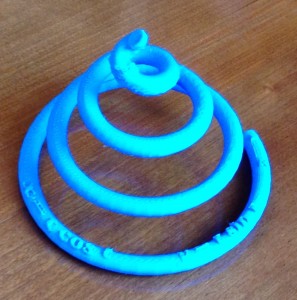
 t failed a few of times due to a tangled filament
  I used the FormLabs printer to create a model of a space curve from Stewart’s Essential Calculus (Section 10.7, exercise 18). The first challenge was to draw the object in Cinema 4D without a self-intersection (3D printers do not accept intersecting geometry). Professor Denne suggested that I make two half-curves that intersect, then make a Boolean out of them. The suggestion worked, so I was then able to put text onto it. It was tricky to figure ou


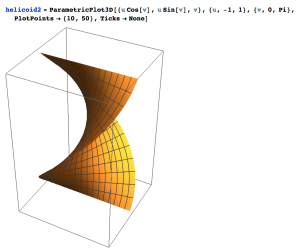 After making them the correct size I optimized the polygons and extruded them by 0.20 cm (a process I can now do very quickly after all my practice with the quadratic surfaces). I then printed each of them on the liquid printer and had fantastic results!
  The .STL and .form files for both of these helicoids can be found on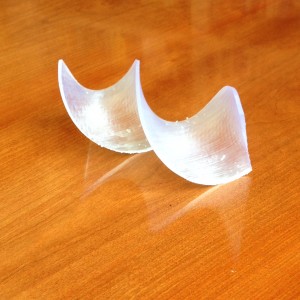


 o the inputs \(x(t),\, y(t)\), and \(z(t)\). For the first
  th
th 

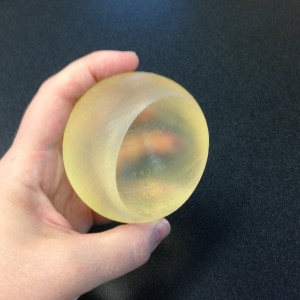

 I also had to reverse the normals on half of the object to make sure they were all aligned with the other half before I extruded the surface. I optimized the polygons to be sure the edges joined up into one object. I then extruded the surface to create my hyperboloid of two sheets. I copied this and put equations through one of them. I also made sure to Boole the edges of the hyperboloid to make them flat for printing.